
Learn about the causes we are fighting for and how you can get involved.

Narrow your search or read everything.

I want to learn about
Choose format
Reset filter
The Legal Battle to End AI Abuse – An Interview with Jess Asato MP

Jess Asato, MP for Lowestoft, announced in June she was taking Elon Musk’s company xAI to court. In January, Jess Asato discovered someone had used the generative AI tool Grok to create deepfake images of her in a bikini without her consent. This was after the MP had criticised the spread of deepfake pornography online and it was calculated to degrade and humiliate her. Susan Galloway spoke to Jess about the legal case, as well as her wider campaigning to protect women and girls in the UK from online harm.

Photograph credit: Jessica Redmond-Withey Asato ©House of Commons/Laurie Noble
Trade Unions Reply to Women on TUC Motion 17

Union members have been writing to the unions to ask if they supported the recent TUC Motion 17 on the EHRC Code and Supreme Court ruling on the Equality Act. FiLiA Trade Union Women’s Network suggested five key questions women should ask their unions about this and their position on women's sex-based rights. We have now received responses sent by four unions: Unison, Unite, NEU and NASUWT which we publish here. We are also sharing some replies sent back to these unions by women who are unhappy with the answers they received.

TUC Motion 17 and Women’s Rights

Union members have been writing to their general secretaries to ask them about their union’s position on the recent TUC Motion 17. Unions are starting to respond to these letters and we will be sharing their responses soon. However, women have told us they want to discuss the implications of this motion, and what it means for women’s rights, with other members of their unions and in their branches, so the FiLiA Trade Union Women’s Network have produced this model motion for women to take to their branch meetings.

Take Action on TUC Motion 17!

Delegates at the Trades Union Congress this week voted to support a motion committing the organisation (and by implication its affiliate unions) to campaign against the EHRC code, which provides guidance on the Equality Act for services, organisations and associations. The motion proposes a serious and substantial change to the legal rights of women and girls and yet no mention is made of this in the motion. The FiLiA Trade Union Women’s Network has produced a short model letter for union members to send to General Secretaries, which asks five key questions. If you are a member of a union, please consider sending this letter to your General Secretary. Just copy and paste the text and send it to your General Secretary either by email or post.

What Do We Know About Prime Minister Burnham’s Approach to Tackling Violence Against Women?

The blog queries the Prime Minister’s approach to VAWG, saying we know only what he did as Mayor of Greater Manchester; he has been quiet on the subject since becoming leader. There are some promising indications from his time as Mayor but unless he gets two core issues right soon, there is little chance to make serious progress towards elimination: a realistic appreciation of how widespread is sexual violence in particular and proper follow through between domestic and international policy. The PM urgently needs to set out his thinking and his vision.

Debating the EHRC Code of Practice at This Year’s TUC Congress

This year’s TUC Congress takes place in Brighton between 13-16th September. On the agenda is a motion submitted by the TUC LGBT+ Conference, opposing the EHRC Code of Practice. The motion raises important issues for the majority female membership of trade unions, and for lesbian and gay trade union members.  In this blog we present the motion, along with some questions that TUC delegates may wish to raise at their delegation meetings or in their local branches and regional/national assemblies.

Joint Statement from Project Resist and FiLiA on the Home Office Guidance for Asylum Seekers

Joint Statement from Project Resist and FiLiA on the Home Office Guidance for Asylum Seekers: it’s time for this Government to target widespread misogyny, tackle the crisis of violence against women and girls and stop scapegoating migrants. The purported aim of this questionable publication is to inform asylum seekers about UK law and so-called societal norms on gender equality and public respect. However, it serves to fuel the far right’s anti-immigration agenda, which has led to widespread violence and pogroms against migrants in recent years.

FiLiA Calls on UNISON, USDAW, ASLEF and The Musicians’ Union to Change Stance on Labour Women’s Conference

Four unions are boycotting Labour Women's Conference because it is adhering to the law on women's spaces. The FiLiA Trade Union Women’s Network has sent this letter to the General Secretaries of each union to express our incredulity at this stance. We are also publishing it here.

Policy with Women in Mind

FiLiA’s Making Policy Work for Women campaign calls on policy makers to make policy feminist – to incorporate the differential impacts on women in the design and development of all policies and to use robust sex-disaggregated data and evidence and meaningfully engage with and involve women in policy making to identify those impacts. This article shows, using real case studies, why this is essential to make government policy more effective, efficient and equitable and to avoid the risks of legal challenges, costly redesigns and reputational damage.

 The EHRC Code of Practice Has Finally Been Laid

This is a significant legal and political moment: the Minister for Women and Equalities has laid guidance from the Equality and Human Rights Commission (EHRC) about how organisations should apply the law under the Equality Act 2010, more than a year after the landmark Supreme Court judgment in For Women Scotland v The Scottish Ministers.
Women can use this moment to organise, scrutinise and challenge institutions that continue to deny women their lawful single-sex spaces, services and associations.

Joint Statement from Project Resist and FiLiA on ‘Earned Settlement’

Following our co-produced response (alongside LISG and women in the FiLiA Women's Assembly) to the Government's consultation on the 'Earned Settlement’ policy, Project Resist and FiLiA have released a joint statement calling on the Government to reconsider the policy in its entirety. If enacted, it will have a terrifying impact on the poorest and most vulnerable migrants, particularly women. The political direction of travel could not be clearer, and we must resist. Read the statement and join our call here.

Amplifying Women’s Voices on the Harms of Surrogacy

FiLiA has a lengthy history in highlighting the harms of surrogacy and egg donation on women and children, and also in supporting action and activism to address this violation of women's human rights. The FiLiA Women's Assembly, a growing network of women across the UK, recently arranged a focus group in order to respond to a new consultation on surrogacy. A consultation which signalled that the threat of surrogacy law reform, with a potential relaxation in the laws which govern this exploitative practice, persists. There is, however, a powerful, grassroots movement of women in FiLiA Women's Assembly mobilising resistance.

FiLiA’s Parliamentary Event – The Speeches

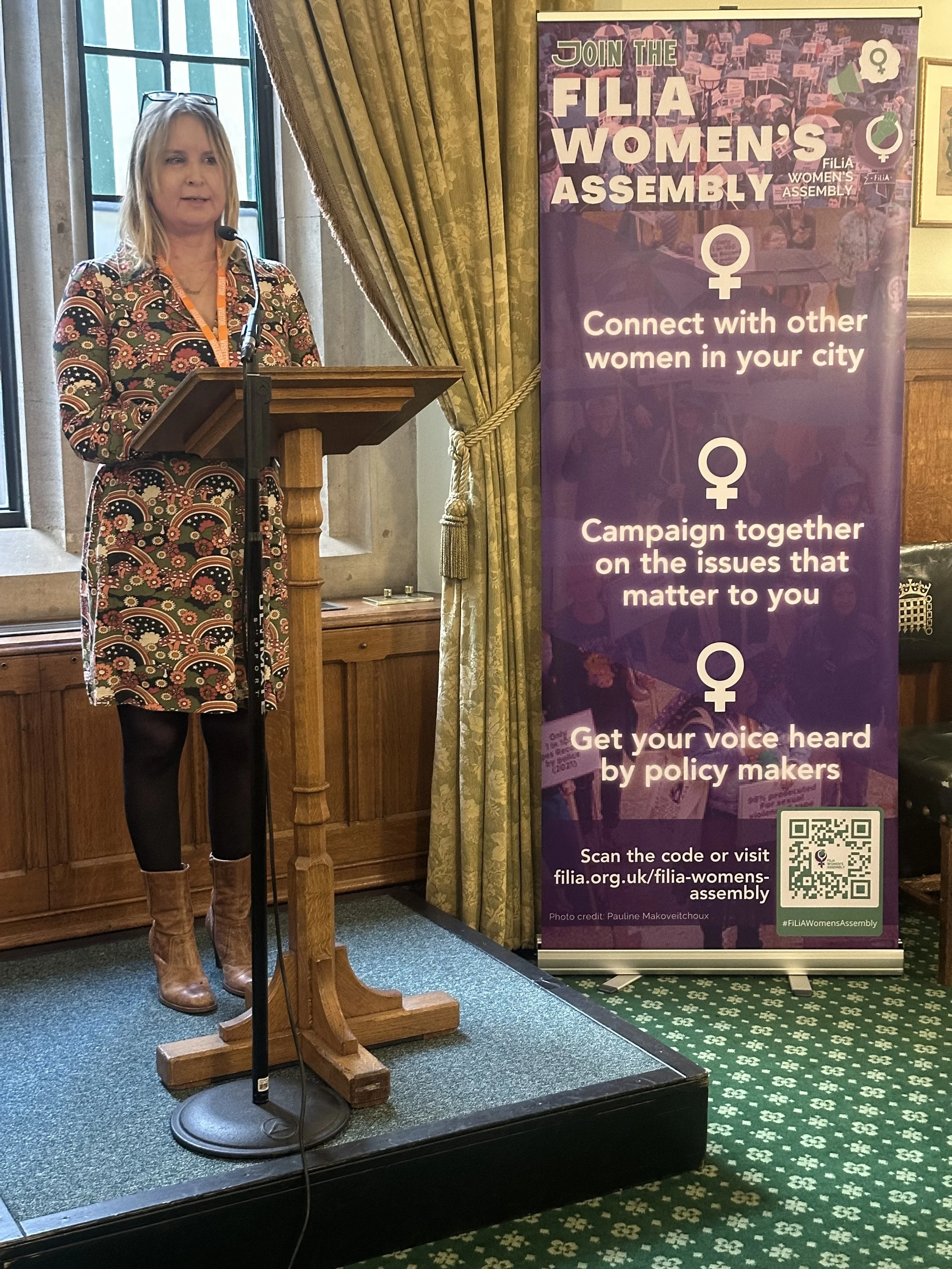
The FiLiA Campaigns and Policy team are pleased to have formally launched the FiLiA Women's Assembly (FWA) and our new report, Making Policy Work for Women, with an event in Parliament on Wednesday 19th November 2025. We are very grateful to Tonia Antoniazzi MP for being our Parliamentary sponsor for this event. She, Fran, a member of the FiLiA Women’s Assembly, and Kruti, FiLiA’s Director of Policy, all gave short speeches at the event and we are proud to share them here.

Letter in support of Dr Mary-Ann Stephenson

FiLiA warmly welcomes the Government’s choice of preferred candidate for the next Chair of the Equality and Human Rights Commission (EHRC), Dr Mary-Ann Stephenson. As part of the process, she appeared in front of two Parliamentary committees and her performance was assured, knowledgeable, and principled. It is clear the Government made the right choice. We are extremely disappointed, therefore, to learn that the Committees are not endorsing Dr Stephenson. We have written to the Minister for Women and Equalities to express our support for Mary-Ann.

Women speak out against the welfare reforms

FiLiA has spoken to women across the UK with disabilities or caring responsibilities about the Government’s welfare reform proposals.  It is clear from what they have told us that the reforms could lead to significant harm – as we set out in our response to the Department for Work and Pensions’ consultation, Pathways to Work: Reforming Benefits and Support to Get Britain Working Green Paper. Further detail, as well as our response and Parliamentary briefing can be found here.

Women respond to the Government's disability benefits reform consultation

The FiLiA Campaigns and Policy team have been working to support women to contribute to the Government’s consultation on disability benefits reform. We wrote to Parliamentarians who are also working to support disabled people to share our work and some of the responses we've had, and invite them to support and work with us to stand up for disabled women and carers who could be devastated by the proposed reforms.

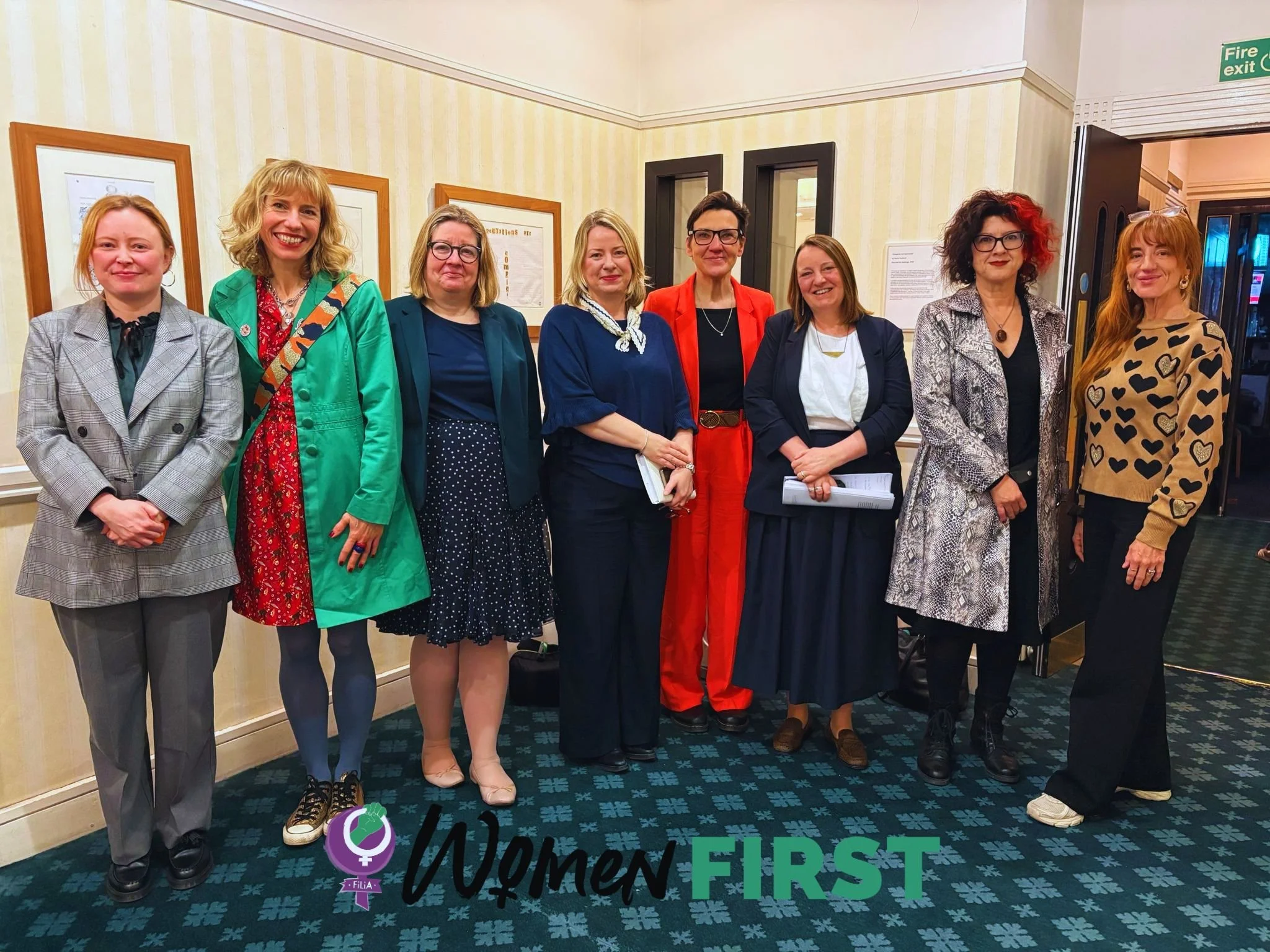
FiLiA Women First and FiLiA Women’s Assembly in Holyrood

We left the day in awe of Ash and her team in pushing forward with this important bill. We will continue to support it. We know that the more we move towards positive change, the louder the voices of opponents will be. We will continue to amplify the voices of survivors and encourage as many women as possible to support this bill and bring change.

Women First at Westminster

When we spoke to survivors as part of our Women First interviews, they told us how important it is that women are asked about moving on from prostitution. We recognise that supporting a woman to move on is complex; there is no one-size-fits-all approach, and it is important that there is support across a range of needs: health, financial, housing, trauma. However, a fundamental starting point is actually asking a woman about moving on

For Women Scotland Supreme Court Victory

On Wednesday morning, in a packed courtroom at the Supreme Court in London, the judgment in the For Women Scotland v The Scottish Ministers (FWS2) case was handed down. The Supreme Court unanimously agreed that the terms ‘man’, ‘woman’ and ‘sex’ in the Equality Act 2010 refer to biological sex. Holding a GRC does not change sex for the purposes of the EA2010. The court ruling makes clear to all what ordinary women across the UK have been saying for years: the law protects single-sex spaces and services.

Equality Impact Assessment: An Underrated Tool for Lasting Feminist Change!

Many of the women we have spoken to feel frustrated with decision makers who seem blind to the female perspective or the impact their work has on women.

Behind our laws, practice and provision, workplace policies or budget cuts, there’s often an invisible bias ‒ one that disproportionately adversely affects women.

And the impact is felt even harder by those at the intersections of race, disability, class and migration status. Too often the needs of women with disabilities, ethnic minority and migrant women, lesbians and women living in poverty are ignored, their voices sidelined, and their struggles compounded by policies that never considered them in the first place.

FiLiA’s view on the planned cuts to disability benefits

Then once they've grown into women, the medical model dismisses women as exaggerating pain ‒ simply walking hysterical hormone sacks fainting at the slightest breeze. 

Maybe they grow up and find someone to love and support them? But abuse and exploitation of disabled women figures show they are more vulnerable and have fewer services available for them. There are less shelters; they are less able to just quickly jump on a free train and escape and risk losing the services and medication they need. 

FiLiA’s statement on the Bertin Review and the Government response to it

FiLiA's detailed response to the Bertin Review published last week, in which we drew on the experiences shared by Women with direct experience of the industry, and we continue to push for them to be consulted in any further reviews. We welcome the Review and its recommendations and are reassured to see the Government recognise the urgent need to tackle the harms of pornography. However, we are clear there is no such thing as ‘safe’ pornography and more needs to be done to protect and support women and girls who are harmed by pornography.

International Women's Day 2025 House of Commons Debate Briefing

The House of Commons held a general debate for International Women's Day on Thursday 6th March 2025. This briefing, sent to MPs to participate in the debate, introduces FiLiA’s new campaign to urge the Government to better recognise and consider women in their policy making, including by consulting with a variety of women's organisations for all policy affecting the public, and consistently producing thorough Equality Impact Assessments.