
Amplifying Women’s Voices on the Harms of Surrogacy
Julie McGee, FiLiA Surrogacy lead and Women’s Assembly lead
Cover image from FiLiA2023 Anti-Surrogacy Rally
Photo Credit: Pauline Makoveitchoux
FiLiA has a lengthy history of speaking out on the harms of surrogacy, including through the following statements and blogs:
Our statement about a surrogacy workshop by the Royal College of Midwives
A Thriving Industry of Surrogacy in the Global South Demonstrates its Harms for Women Everywhere
When FiLiA came to Glasgow in October 2023, a local campaign group I was involved in, Glasgow Tactical Feminists (GTF), had the opportunity to organise an activist action at conference.
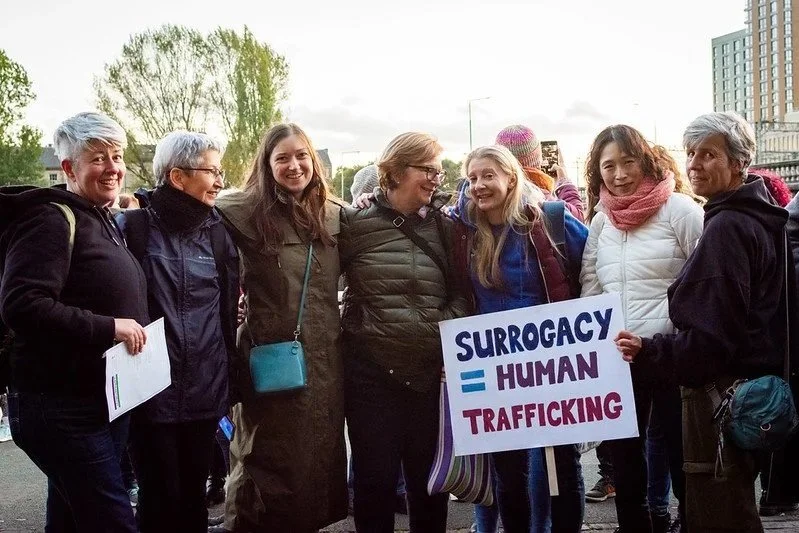
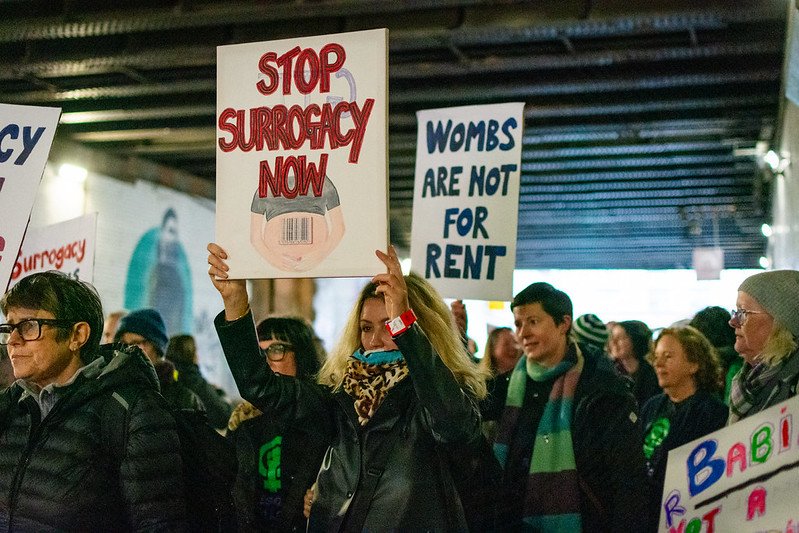
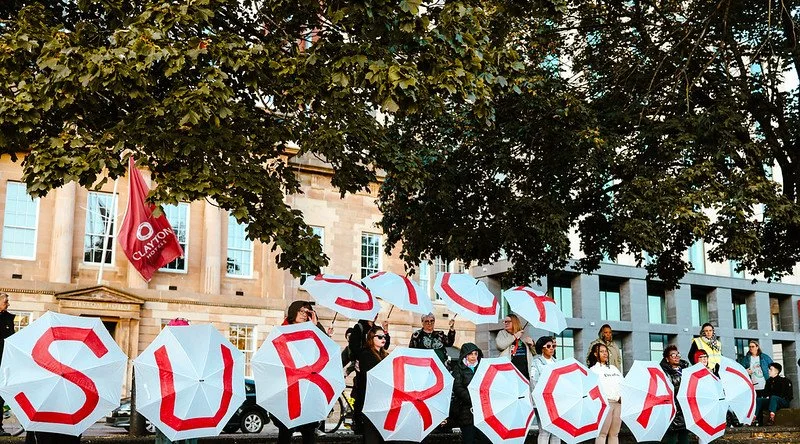
GTF consulted with Scottish women’s groups and there was a call to highlight the harms of surrogacy. We held a march at FiLiA Glasgow arranged alongside the Scottish Women’s Coalition on Surrogacy, Surrogacy Concern and Stop Surrogacy UK – where we stopped the traffic in the city centre and held a rally with global voices of women in the fight against surrogacy. Speakers included Helen Gibson of Surrogacy Concern, Marie Joseph Devilliers of International Coalition for the Abolition of Surrogate Motherhood, Anna Zobnina of European Network of Migrant Women and local feminist organiser, Freya MacKenzie. They highlighted our opposition to the commodification of women’s bodies, the harmful impact of surrogacy on women and children, the coercion and exploitation of the growing global surrogacy market and our concerns about the draft Bills (see below). Surrogacy is a practice which inherently violates women’s human rights and the draft Bills fail to stop this exploitation.

The Law Commission of England and Wales and the Scottish Law Commission had published their draft Bills to reform surrogacy law across the UK a few months earlier. FiLiA shares women’s concerns about the content of the draft Bills and, alongside around half of responses, had expressed fundamental opposition to the Law Commissions' proposals. Both the Conservative administration in place at that time and the subsequent Labour government have reiterated that they do not intend to prioritise surrogacy law reform. Baroness Merron, Parliamentary Under-Secretary of State for Health and Social Care, confirmed this in April 2025 in her letter to the Law Commission of England and Wales.
FiLiA was therefore concerned to see that POST, the Parliamentary Office of Science and Technology, an ‘impartial research and knowledge exchange service based in the UK Parliament’ was holding a consultation on surrogacy, describing the current law as ‘outdated’ and using biased language in its call. POST announced its consultation on 1st August this year with the consultation closing on
5th October. Whilst the reason for the consultation was cited as being to ‘describe current surrogacy practice in the UK, and suggestions for reform’, the scope to respond meaningfully was significantly inhibited by a frustratingly restricted word count. There was only scope within the consultation to essentially answer two questions, within a 500 and 1500 character count. The consultation sought, within these brief limits, feedback on what the key issues were around surrogacy in the UK.
That women are concerned about the harms of surrogacy is evidenced through the research FiLiA’s Campaigns and Policy team conducted in 2024 on grassroots women’s concerns and priorities.
The FiLiA Women’s Assembly (FWA), a new network of women across the UK and an important part of the Campaigns and Policy team, exists to connect women and ensure that women’s voices are heard by policy makers. The work of the FWA includes supporting women to participate in formal consultations (a recent example being the disability benefits reform consultation, read our statement and our full response). We wanted to make sure that women both had the opportunity to contribute to FiLiA’s response to the consultation and to have support, if needed, their own response.
We therefore held a focus group on the POST consultation in September this year, which was attended by women from across the UK. Women raised their concerns about surrogacy, covering a broad range of issues affecting women and their children globally. These included:
Exploitation and coercion: Surrogacy exploits women’s poverty. Even where presented as ‘altruistic’ with ‘expenses’ paid, surrogacy inherently involves taking advantage of economically disadvantaged women. Women also often experience familial pressure and subsequent harm in so-called ‘altruistic’ arrangements. Young women are also exploited without full information about the impact of surrogacy on their potential future motherhood experience.
Commodification of women's bodies: Surrogacy turns woman's reproductive capacity and the resulting child into a commodity or product. Commercial surrogacy essentially places women’s wombs up for rent and involves the sale of children. It is human trafficking and a form of violence against women.
Health and bodily autonomy: Pregnancy and childbirth carries inherent physical and mental health risks with the risks to women in surrogacy significantly higher. Additionally, this places extra demands (and associated costs) on the NHS.
Erasure of motherhood and maternal bond: Surrogacy erases the biological and emotional meaning of motherhood as well as removing children’s fundamental rights to know their origins. The psychological impact on both is harmful and lifelong.
The global trade in surrogacy: The Law Commissions' reforms do not address the global trade in surrogacy – of UK citizens exploiting women in low or middle income countries, trafficking children to the UK. Some countries, such as Italy, have classified surrogacy as human trafficking
We then had the task of representing these concerns within a character limit that was beyond frustrating. You can see our extremely limited response below and no doubt share both our vexation at the depth of response allowed and our concerns for this to inhibit the potential for meaningful consultation.
FiLiA’s response to the POST consultation
~
FiLiA’s response to the POST consultation ~
Question 1: Please explain briefly how your research expertise is relevant to the POSTnote. 500 characters
FiLiA (charity) works to defend women’s human rights; longstanding interest evidenced – published papers and conference agendas:
Our statement about a surrogacy workshop by the Royal College of Midwives — FiLiA
#50 Surrogacy: A Human Rights Violation – FiLiA Conference 2019 — FiLiA
Question 2: What key issues are relevant to the POSTnote that you would like to make us aware of? 1500 characters
Surrogacy is harmful to women and children; inherently exploitative, commodifying and objectifying women’s bodies, exposing women and children to serious human rights violations (UN Report from the Special Rapporteur for Violence Against Women and Girls on surrogacy). Surrogacy exploits women’s poverty. UK ‘reasonable expenses’ are undefined in law – can be up to £35,000, a significant financial incentive. Women in low / middle income countries are drawn into surrogacy through financial necessity – c£12,000. Even where seemingly ‘altruistic’, outcomes for surrogate mothers and children are poor. Regret and coercion often feature. There is a growing body of adults born in surrogacy, speaking out on damage caused. Physical risks in surrogate pregnancies are unacceptable and substantiated. Surrogate pregnancies result in a 3 times higher risk for Sepsis, Pre-Eclampsia and Post Partum Haemorrhage, surrogacy results in a higher risk of mental health difficulties and of low birth weight / premature birth. The UK is an outlier. Other countries recognise ethical concerns. Surrogacy is banned in France, Germany, Italy, Spain, Finland and many more countries. In the 2019 UK Surrogacy consultation, over 50% of responses confirmed favour for a complete ban. We are keen to be involved in any further consultation.
FiLiA has emphasised that we are keen to contribute further to POST’s research on surrogacy law reform and we will continue to work alongside grassroots activists within the FiLiA Women’s Assembly and other women’s groups and organisations concerned with ending this abominable practice to ensure their voices are heard by UK politicians and policy makers.