
Trade Unions Reply to Women on TUC Motion 17
In September this year, delegates at the Trades Union Congress voted to support a motion committing the organisation (and by implication its affiliate unions) to campaign against the EHRC code. The motion proposes a serious and substantial change to the legal rights of women and girls and yet no mention was made of this in the motion.
The FiLiA Trade Union Women’s Network (TUWN) produced a short model letter for union members to send to General Secretaries, which asks five key questions. Thank you to everyone who has already contacted their union.
We have been sent responses from Unite, Unison, NEU and NASUWT, which we share below.
We are also sharing examples of follow-up emails sent to two of these unions by women who are unhappy with the response.
The correspondence is reproduced here as it was sent to us. Only personal details have been deleted.
If you haven’t already done so, please do write to your own union’s General Secretary using our model letter.
We want to know what the position of every union is to women’s rights.
What Next?
1. Keep contacting your union
Please keep writing to your union to ask them to clarify their position on women’s rights. This discussion is vital to ensure that they are properly representing and acting in the best interests of all their members.
Please send us any response you get and any follow-up email you send to clarify their answers. We can share these publicly so that more union members are informed about their union’s position and intentions.
2. Table a motion in your union branch or regional forum
We have drafted a model motion for union members to take into their local organising fora to generate awareness and discussion of what TUC Motion 17 means for women’s rights. We already know of one union branch that has passed a motion based on this template. Let us know how you get on.
3. Get involved in the FiLiA TUWN
If you are not yet a member of the FiLiA TUWN, you can join here. You will get regular newsletters and be able to connect with other women in your union and your TUC region/nation.
Union Responses
〰️
Union Responses 〰️
-
This is a response to emails sent to a generic contact address for Unison which were forwarded to Out@Unison for a response.
UNISON is committed to supporting and representing all our members and also to campaigning for the policies agreed through our democratic conferences and by our lay member elected committees.
UNISON’s policy, agreed and reaffirmed through our democratic structures, is clear:
• trans rights are human rights;
• trans women are women;
• trans men are men; and
• non-binary identities are valid and should be recognised in law.The UNISON delegation to TUC congress supported the motion. This was in line with current UNISON policy, both from our national delegate conference where a motion similar to the TUC motion was overwhelmingly carried, and our national women's conference, who have carried a motion that opposes the EHRC interim guidance this year.
-
Thank you for your letter/email.
UNISON’s policy, agreed and reaffirmed through our democratic structures, is clear:
• trans rights are human rights;
• trans women are women;
• trans men are men;
• non-binary identities are valid
• and these identities should be recognised in law.UNISON remains committed to these principles and will continue to campaign in support of them, alongside our wider policies and objectives. At the same time, as a democratic trade union, we have a responsibility to comply with the law as it currently stands. The law, government policy and workplace practices will not always reflect UNISON’s policies. There have been many legal and political decisions over the years with which we have disagreed, but where the law applies to our activities, we must comply with it while continuing to campaign for change. The Supreme Court judgment in For Women Scotland Ltd v The Scottish Ministers, followed by the Certification Officer’s decision in Flaherty v UNISON, has clarified how the law applies when UNISON uses the positive action provisions of the Equality Act 2010. In these circumstances, references to sex must be understood and applied in line with the legal meaning set out by the Supreme Court.
As a result, UNISON has made changes to the relevant eligibility criteria, policies, procedures and guidance where these rely on the positive action provisions of the Equality Act 2010. These changes are necessary to ensure that our processes comply with our current legal obligations.
These changes do not represent a change in UNISON’s democratically agreed policies. They reflect the difference between our responsibility to comply with the law as it currently stands and our right, as a democratic trade union, to campaign to change that law.UNISON remains committed to supporting and representing all our members and to campaigning for the policies agreed through our democratic structures.
In relation to your questions:
1. UNISON supported motion 17 because it is in line with existing policy and the wording of the motion closely resembled a motion passed at previous UNISON conferences.
2. Yes, UNISON recognises that the Equality Act provides for women only spaces, and that since the ruling of the Supreme Court ‘sex’ in the meaning of the Equality Act is sex assigned at birth.
3. The union accepts and supports the provision of positive action to address the under representation of women, and the union supports the range of services you mention. Indeed, many of our members work in those services and are very proud to do so.
4. The union will campaign to see our policies implemented, this includes where appropriate legal rights to provide better protection and recognition for Trans people and those who identify as non-binary. We are not campaigning to remove any rights from any group with a shared protected characteristic.I hope this answers your questions. I would like to reassure you once again that UNISON remains firmly committed to supporting and representing all of our members through our democratic structures.
We welcome open and constructive debate on all issues and encourage members to engage with one another respectfully, in a way that is consistent with the values and principles set out in our Rule Book.
-
Thank you for your email, which I have been asked to respond to. Please accept my apologies in the delay in getting back to you.
Unite’s approach on this matter has for many years been decided on by our National Women’s Committee and our LGBT+ Committee.
We believe that supporting women’s rights and supporting the rights of trans and non-binary members are not competing principles.
All workers have a fundamental right to safety, dignity, equality and protection from discrimination. As a trade union, our responsibility is to defend all our members against discrimination and to campaign for effective protections that enable everyone to live and work with safety, dignity and equality.
There is a working group comprising senior lay representatives from both our Women’s Committee and LGBT+ Committee which is currently reviewing the legal position and looking at what legal protections we should be advocating in this space.
We will continue to listen to the experiences and concerns of members affected by these issues and consider how we can campaign for improvements where the existing legal framework does not provide the level of protection our members need.
Unite will also continue to operate in accordance with the law.
-
Thank you for your response.
Having read it carefully, I’m disappointed that you haven’t directly answered any of the five questions I raised in my original letter.
I appreciate that Unite has a responsibility to represent all its members, but my questions were specifically about the existing legal rights of women and girls under the Equality Act, and the Union’s position on those rights.
My first question was simply whether the Unite delegation supported Motion 17. This should be a fairly straightforward question to answer, yet it hasn’t been addressed at all. Nor have you explained on what basis the delegation decided to support the motion, if indeed it did.
You state that Unite believes women’s rights and the rights of trans and non-binary members are not competing principles. However, this doesn’t answer my questions about women’s legal entitlement to single-sex provision, or whether the Union supports the exceptions within the Equality Act intended to protect those rights.
You also state that Unite will continue to operate in accordance with the law. I would certainly expect it to. However, complying with the law and supporting the retention of the rights it provides are two different things.
I’m also concerned by your reference to a working group reviewing the legal position and considering what protections Unite should be advocating. Is the Union proposing to campaign for changes to the Equality Act, including the removal or restriction of the existing single-sex exceptions? Again, this was one of my original questions.
You also say that Unite will continue to listen to the experiences and concerns of members affected by these issues. Please could you clarify exactly which members are being consulted? Are women who support the retention of single-sex protections being included in these discussions, particularly those who have raised concerns about Motion 17?
I would have thought that women who disagree with the Union’s position, or who are concerned about the implications for their existing legal rights, should have just as much of a say in these discussions.
Since sending my original letter, I also understand that Unite was among the trade unions that deliberately boycotted the Labour Women’s Conference at this year’s Labour Party Conference. Please could you explain how the decision not to send delegates to a conference specifically intended to represent women’s interests demonstrates support for, or respect towards, the Union’s female members? Were those members consulted before this decision was taken, and on what basis was it made?
I don’t believe any of my original questions were unreasonable. These are matters of considerable importance to women and girls, and I think it’s entirely reasonable for women who are also trade union members to expect clear answers from their Union.
I would therefore appreciate a direct response to each of my original five questions, together with clarification of the additional concerns I’ve raised here, rather than another general statement about equality and discrimination.
I look forward to hearing from you.
``````````````````````````````````````````````````````````````````````````````````````````````````````````````````````````````
Thank you for your response. However, I don’t think you answered my specific questions below and I would be grateful if you would do so.
I of course agree that supporting women’s rights and supporting the rights of trans and non-binary members should not in and of themselves be competing principles. However, there is no doubt that this has been happening to the detriment of women and when women try to raise these issues they have been silenced. Therefore, there are some areas where there is a need for absolute clarity on the union’s position.
With regards to women’s Equality Act rights, specifically our rights to single sex spaces and services in circumstances where we are vulnerable, can you clarify what Unite’s position is? Does the Union support women’s rights to single sex spaces consistent with the definition of sex under the Equality Act, confirmed by the Supreme Court ruling, where it is a proportionate response for our dignity, privacy, safety and representation? I am particularly thinking of spaces where women are vulnerable such as changing rooms, domestic abuse refuges, rape crisis services, prisons etc And reserved seats for women established to challenge the oppression we face because of our biology.
Of course trans and non-binary members also have a right to be safe and represented but does the union accept that ways must be found to protect trans rights in a way that does not impact on women members’ Equality Act rights?
I would appreciate a response to my original and subsequent questions and look forward to hearing from you.
-
Inquiry about NEU position at TUC on motion 17 EHRC
Thank you for your recent letter. In your letter, you have asked a series of questions.
The NEU delegation in Brighton did support the motion to which you refer. The delegation voted for the motion because the Union’s position, determined at Conference, is to defend employment rights and social participation for trans and non- binary workers. The motion which was before the TUC was in line with decisions taken at Conference.
The Union doesn’t make comment about non educational spaces such as rape crisis centres, prisons and domestic abuse refuges because these are not educational spaces. We don’t organise in that sector.
Challenging sexism and women’s inequality is a trade union issue, clearly. As you know, the NEU is active around the serious levels of violence against women and girls, and wants to see education used to prevent it. The NEU also campaigns actively on issues such as pregnancy and maternity and women’s pay progression. At the summer Festival of Education conference, we hosted a panel with Laura Bates about misogyny and why education must prevent misogyny- the event was standing room only. The Union continues to organise around the It’s Not Okay toolkit on preventing sexual harassment.
The Union supports the Equality Act and sex discrimination provisions, aimed at advancing women’s rights, are essential. However, it equally supports employment and other rights for trans and non binary workers, who face significant patterns of discrimination and stigma. NEU Conference and the Executive have taken decisions which are clear that trans members should be able to self- identify and to access education and workplaces, on the basis of self ID. The NEU will campaign for that position.
The Union will comply with the law as it currently stands and the For Women Scotland ruling and will provide factual information to members.
It’s also important to identify the shared interests – we want all NEU members working together to achieve the conditions and culture in schools which benefit sex equality and LGBT+ equality – fairer funding, smaller class sizes, stable staffing, an engaging curriculum and motivated education staff, with time to know and inspire their students. There is a lot that we need to change in education – and the NEU is the Union that will organise and campaign to do this.
-
Thank you for the reply to my recent letter regarding the NEU position at TUC on motion 17 EHRC.
I understand that the delegation will have voted to determine their position in line with current policy but I would like to understand if this included union policy related to women and girls, specifically:
Was there any discussion on how supporting Motion 17 would impact union policy on women and girls?
Was any information provided to the delegation as to how this motion might impact on any such policy?
I am very proud to have been part of the NEU (at workplace, branch, regional and national levels) as it developed its work as a social justice union. Whilst we may not organise workers in prisons, rape crisis centres and domestic abuse refuges we certainly have policy and debate relating to these issues. For example, at Conference 2022 we passed the motion ‘Mothers in prisons and the impact on their children’. We also have a model domestic abuse policy for use in the workplace and we frequently have motions to conference addressing sexual harassment and violence towards women and girls, not just in schools and colleges but in wider society.
We are a Union who rightly speaks out against injustice in its widest forms. The very fact that we have debated prisons, domestic abuse and violence against women and girls means that we have work that is intrinsically linked to those sectors and that we are often recommending specific actions or organisations. We need to be certain that in doing so we are defending and supporting the rights of our women members and the students we teach.
As you say, challenging sexism and women’s inequality is a trade union issue and as you also say the NEU has been active in its work in this area. Was consideration taken on how this motion would impact services that are provided for the students we teach, the communities that we work in and the services that our staff need to access including those listed in the NEU workplace domestic abuse model policy?
I am heartened to hear that the Union supports the Equality Act and the protections it affords all those with protected characteristics.
Am I to understand, therefore, that the Union will maintain its support for the Equality Act 2010, including the provisions for single sex exceptions as outlined in the recent For Women Scotland Supreme Court ruling? Given that the membership of the NEU is around 75% women, I am looking for reassurance this is the case.
I would also like to know whether the NEU will support the rights of the girls and young women we teach to access single-sex provisions in schools and colleges such as toilets, residential accommodation, and changing facilities.
As a member of the Union for many years, I am extremely proud of the equalities work we have been involved in and would like to think that as an active member of the Union I campaigned to improve the conditions and culture in schools so that staff and students felt heard in schools. I agree that we all still have much to do and I am sure the NEU is a key player in this work. I am sure you will agree that women and girls are key to that being successful. I sincerely hope that the NEU considers best how to ensure and promote, rather than restrict and undermine, the rights of women, our involvement in the union movement and education and access to vital services that meet our needs.
-
Thank you for writing to NASUWT regarding the motion at the recent TUC Congress, ‘Oppose the EHRC Code of Practice (Services, Pubic functions and Associations)’. I note that you have also submitted the same letter to a number of NASUWT National Executive members. This response should thus be considered as a reply to all those at the NASUWT that you have written to in this regard.
We recognise that the Supreme Court judgment and the EHRC Code raise important issues for women as well as LGBTI members. I am therefore writing to provide you with a clear account of NASUWT’s position.
NASUWT’s position and its vote at Congress
NASUWT’s delegation voted in favour of Motion 17 at TUC Congress, along with other affiliate unions We did so because of our concern about the Code’s practical impact on trans and non-binary people, including teachers, and our longstanding support for stronger legal recognition and protection for them. The vote did not mean that NASUWT opposes women’s single-sex provision. Our published policy expressly recognises that the legal exceptions protecting single-sex spaces are fundamental to securing and advancing women’s rights. We are committed to protecting women members’ rights, including their safety, privacy and dignity.
In fact the ‘safe space’ annual NASUWT Women’s Consultation Conferences provide a programme of work and campaigning priorities for advancing women’s rights in the workplace as well as society in general.
What does the Supreme Court judgment mean?
You are right that the Supreme Court held that “sex”, “woman” and “man” in the Equality Act 2010 refer to biological sex. NASUWT accepts that judgment and will work within the law. It means, among other things, that the Act’s provisions for separate and single-sex services must be understood on that basis. Supporting Motion 17 does not change the judgment or remove women’s protections.
You are also right that the judgment did not abolish protection against discrimination because of gender reassignment. The Court made that clear. Our concern is that a person may retain a legal protection while still facing serious practical difficulties in accessing facilities or services safely and with dignity. It is legitimate to question whether the Code gives organisations sufficiently workable guidance on meeting their duties to everyone affected.
The Court considered how its interpretation relates to pregnancy and maternity protections and to lesbian-only spaces and associations. NASUWT is not seeking to take away those protections. We support both effective sex-based protections and stronger protection for trans people. Our support for a simpler gender-recognition process based on self-declaration is a proposal for legal reform; it does not mean that self-declaration currently changes a person’s sex for the purposes of the Equality Act.
What about lesbian and gay members?
Sexual orientation remains a protected characteristic under the Equality Act. The Supreme Court expressly considered the ability to provide lesbian-only spaces and associations when reaching its judgment. NASUWT respects that protection. A vote for Motion 17 should not be read as a claim that lesbians or gay men cannot define or organise around same-sex attraction, or as support for removing their legal rights.
What does the EHRC Code cover?
The updated Code is now in force. It gives statutory guidance on services, public functions and associations. It does not itself make new law, and the EHRC cannot overrule the Supreme Court. The Code can, however, be relevant in legal proceedings, so it is reasonable for a union to scrutinise its account of the law and its practical effects.
The Code is not the statutory employment code. Employers’ duties towards staff also arise under employment equality law and workplace health and safety rules, including requirements concerning suitable toilet facilities. We would consider a concern about a particular school or workplace against the applicable duties and the facts of that case, rather than assume this services Code supplies the complete answer. The rules governing competitive sport also require consideration in their own setting.
In short, NASUWT supported the motion because our members support the TUC in challenging aspects of the Code and to press for stronger protection for trans and non-binary people. We will do that while respecting the Supreme Court judgment and defending the rights of women.
NASUWT shares the concerns of the TUC that the EHRC guidance lacks clarity on how employers can lawfully and practically implement birth-sex verifications without violating the privacy and dignity of trans and non-binary workers, as well as breaching data protection rights.
We appreciate that you may disagree with the Congress motion, and your questions are welcome. NASUWT’s policy supports open, respectful debate on these matters.
What Now?
Keep contacting your union – and let us know what they say.
Table a motion in your union branch or regional forum.
Get involved in the FiLiA TUWN.
Register for the FiLiA webinar: In Defence of the Equality Act.
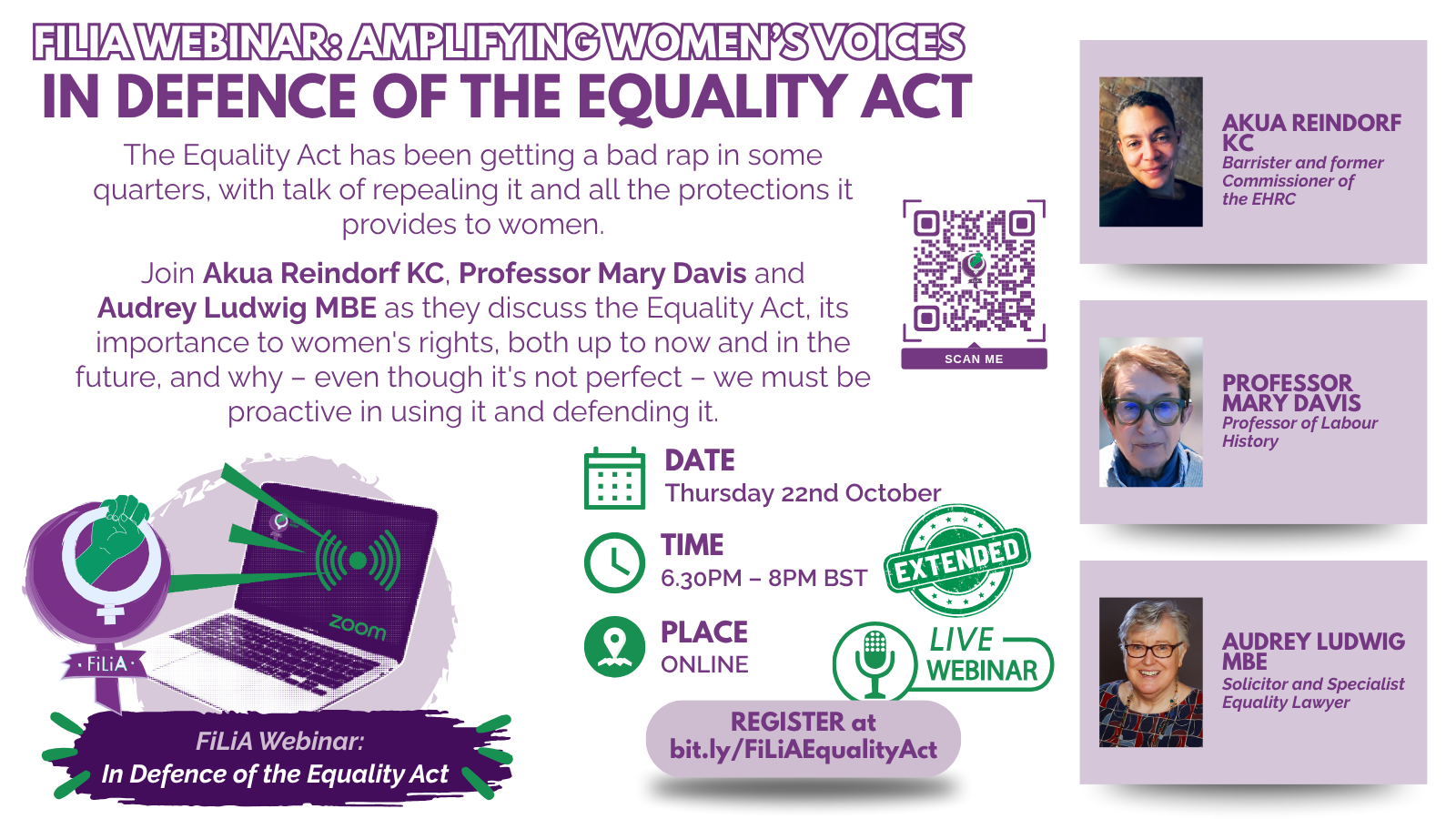
FiLiA Webinar: In Defence of the Equality Act