
The Invisible Killer: Asbestos and the Dangers for Women in the Workplace
This blog is based on a speech given by Susan Aitouaziz for the FiLiA Trade Union Women’s Network Health & Safety is a Women’s Issue webinar.
Held on 26th March 2026, in preparation for International Workers’ Memorial Day on 26th April 2026..
Asbestos is killing more women every year. But evidence shows that many still aren’t aware of the disease and how it can be acquired at work.
Asbestos is a generic name for a naturally occurring fibrous mineral. There are several types, commonly known as white, brown and blue. Mining it is relatively straightforward – it’s found close to the earth’s surface, predominantly in South Africa.
It is lightweight, fire resistant, it has insulting properties, it’s tough, resistant to rust, acid, salt water and frost. It is not eaten by vermin or insects, and it does not conduct electricity. Asbestos is invisible to the human eye, and it’s been used for thousands of years.
Exposure to asbestos fibres can lead to the development of incurable conditions, most notably mesothelioma and various asbestos-related cancers. It was used in a wide range of products, leading to varying levels of risk. Although the first documented asbestos-related death occurred over a century ago, the UK government did not ban asbestos until 1999.
Today, asbestos exposure causes 5,000 deaths annually, accounting for 40% of the United Kingdom’s (UK) occupational cancer cases. The UK has the highest rate of mesothelioma deaths in the world. 17% of these deaths are women; however, new cases of mesothelioma since the 1990s have doubled (97%) in women. (British Safety Council, Clearing the air on asbestos dangers to women, Belinda Liversedge, April 2022).
An increasing proportion of asbestos-related deaths now occurs among women and younger individuals. And yet there is still today, both anecdotally and from research, a lack of awareness among women of the disease and how it starts. Women need to understand that all asbestos can kill and has killed thousands of men and women, and that contact with products containing asbestos or spending time in a building where asbestos is present is dangerous.
One such case is that of Helen Bone. She was diagnosed with mesothelioma in 2021 aged 38. Helen reported:
‘You always think of asbestos as a disease from decades ago – affecting men who worked in heavy industry – so to be diagnosed in my 30s is shocking’.
In an effort to secure compensation for her illness, Helen’s solicitors were faced with the task of finding out whether she was exposed to the deadly asbestos at her primary school, secondary school, at the college where she studied to become a critical care practitioner or at Middlesborough General Hospital and the James Cook University Hospital where she worked from the age of 17. She may have been exposed at several or even all of them. Something terrible had been done to her and her family – of that there is no doubt (Bad Dust, Tom White, 2025).
Britain had a particular appetite for the material known as the ‘Magic Mineral’. Seven million tonnes were imported into Britain between 1870 and the late 1990s. It is present in our built environment, hospitals, schools, homes and public buildings. It remains in the roofs, floor tiles, insulation, garages, sheds, guttering, drainpipes, pipe lagging, water tanks, windows, doors and partitions.
I have found display boards made from asbestos in a school, and sheds on an allotment site nailed together with broken asbestos sheets. The asbestos is far beyond its intended design life and is slowly degrading or has already been disturbed.
The only safe way to deal with asbestos is to remove it. Then you have the problem of where to dispose of it.
So, if we knew it was dangerous, why didn’t we stop mining it?
As early as 1870, physicians had identified an aggressive and untreatable condition affecting the lining between the lungs and the ribcage.
In the 1950s, researchers in South Africa found multiple people suffering from cancers linked to exposure to asbestos. These cases began to show that those not working in the mines but in associated work were dying of mesothelioma. Women who cleaned the miners’ laundry were found to have been exposed to lethal levels of asbestos.
At a conference held in New York in 1964, Molly Newhouse presented her work on the occurrence of mesothelioma among people who lived near to the Cape Asbestos Factory in Barking, London. Unusually, in Barking, women worked alongside the men in direct contact with asbestos at the factory. Between 1913 and 1966 10,142 men and women were employed at the Cape Factory.
Molly found that the company were using giant fans to pump asbestos dust out of the factory, where it landed in back gardens, a playground and Northbury Infant School. Many residents were exposed to high levels of asbestos, but it would take only a single fibre inhaled to result in death, sometimes years later and sometimes decades after moving out of the area.
I first came to know about the factory in Barking in 1991, when I began teaching in the borough. I kept a diary, recording thoughts about my new surroundings and the awful harm caused to those exposed to asbestos in the workplace.
‘They call it the Barking Cough, a tickle in the chest and a slight pain on breathing. Then within months the sufferer was in agony, gasping for air and eventually suffocating to death’.
The Factory was demolished in the 1960s and the land was purchased by the Council, with several flats and houses being built on it. Many of those who lived there or visited relatives were exposed to asbestos fibres and subsequently died from asbestos-related cancers.
Between 1997 and 2003, the estate was demolished; monitoring of the site shows high levels of asbestos present on the surface.
As I read more about the Cape Factory, I saw a disturbing pattern. Reports presumed that the factory only employed men, but I had documents that detailed hundreds of women working at the factory. I looked at the rates of deaths due to mesothelioma in women resident in Barking, and compared them to those elsewhere. Barking had the highest rates of mesothelioma deaths in the UK (Health and Safety Executive, 2015).
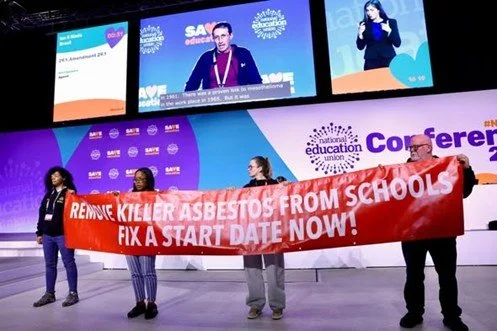
Since the 1970s, a small but dedicated anti-asbestos movement has highlighted the dangers of asbestos, fought for compensation for victims and drawn attention to the risks posed by crumbling asbestos in our schools and hospitals.
In these predominantly female workplaces, it became clear by the 1980s that hundreds of health and education workers were dying of asbestos-related diseases.
In 2020, a retired teacher living in Barking asked the trades union council if they could place a significant memorial to all those who died due to asbestos in the borough. We began raising money from our kitchen tables, locked down during the pandemic. Local and regional branches gave generously, and we received heart-felt contributions from those who remembered the terrible harm and suffering in the borough.
Everyone I spoke to had known someone who had died because of asbestos, and they wanted their lives to be remembered. On 28th April 2022, we unveiled a large granite stone engraved with a memorial to those who had died but also a pledge to fight for the living.

In the same year, the All-Parliamentary Works and Pension Select Committee recommended a 40-year national strategy for the removal of asbestos from schools and hospitals. The Government rejected the report’s recommendations.
This is a difficult subject, and I have moved from anger to despair about what has happened and how people have been treated. But there is hope, there is solidarity and there are a lot of people who refuse to be silent. We know it’s still there. Every workplace with asbestos needs every employee to beware of the dangers.
Join those valiant, persistent, no-nonsense health and safety reps in demanding it is removed from our schools.
Watch a recording of the whole webinar and read and download the resources we created for International Workers’ Memorial Day (with an additional one for International Workers’ Day on 1st May) below: