
Abolition in Action, Celebrating 10 years of the Abolition law with French Sisters
By Sally Jackson – Trustee and lead for Ending male violence against Women and Girls
I’ve recently returned from a packed and inspiring few days in Paris with European sisters, marking the 10th anniversary of France’s abolition law. The programme, organised by The Coalition for the Abolition of Prostitution – CAP International, brought together activists, survivors, politicians and allies from across the world in a powerful show of solidarity and shared purpose.
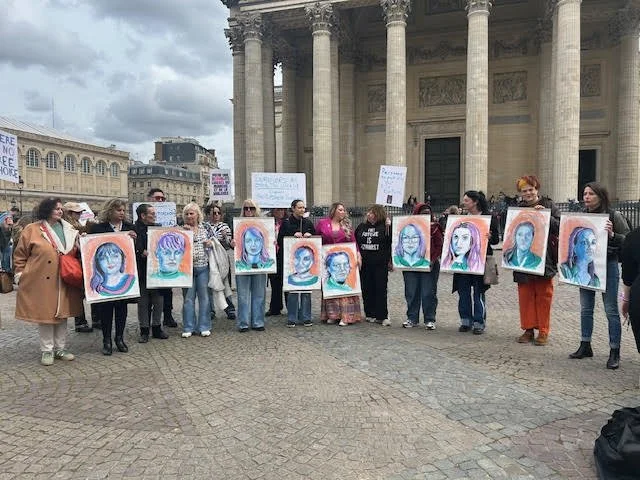
We began with a screening of The Right Track, a moving new film by Janet Jensen. Although based in the USA, it centres survivor voices that resonate globally. We’re now exploring opportunities to bring the film to UK audiences. From there, our feminist posse made its way through the streets of Paris to a banner-making session in a building used to support women in prostitution. Inside, a striking mural painted by a survivor depicted key women in the movement – two of whom we would meet the following day.
With banners in hand, we travelled together on the Metro, women descending escalators in a sea of colour and determination to gather at the Panthéon for the World March for the Abolition of the Prostitution System. The atmosphere was electric as the crowd grew, joined by abolitionist groups from across Europe and beyond. Following speeches and songs, survivors led a powerful march through the streets of Paris. Chants of ‘Abolitionist! Féministe!’ rang out as we walked, drawing strong support from the public. It was both energising and deeply moving to stand alongside women and some men, from countries including France, Norway, Germany, Portugal, Sweden, Switzerland and the USA. We ended at Les Invalides with final speeches, before regrouping for the next day’s conference.
Monday brought a full day of discussion titled Abolition in Action at the French Parliament. With 49 speakers across eight panels, the programme was ambitious and wide-ranging. The conference opened with strong political backing, including from Yaël Braun-Pivet, President of the National Assembly, who highlighted that 92% of the French public now support the law, a clear sign of cultural shift. Aurore Bergé, Minister Delegate for Equality between Women and Men, reminded us that ‘the freedom of some should not be based on the vulnerability of others.’
In the first sessions, speakers reflected on how the law was developed and passed, often in the face of backlash. Former MPs Maud Olivier and Catherine Coutelle spoke about the crucial role of NGOs in pushing politicians to act, despite resistance. Najat Vallaud-Belkacem shared the hostility she faced, including having fake blood thrown at her. Again and again, the message was clear: survivor voices were central to change. Rosen Hicher, a survivor who played a pivotal role, spoke about the importance of being visible and speaking from the heart, thereby challenging perceptions of survivors as ‘poor women’ and instead highlighting them as victims of a system that had failed them.
We also heard honest reflections on how the law is working in practice. Hope, one of the first women to access exit services, shared how it had transformed her life and that of her daughter. She now has stable housing, has learned to drive and is in employment, support that would not have been available without the law.
The conference also looked outward, exploring international progress and ongoing challenges. Contributions from across Europe and beyond highlighted growing momentum for abolition, as well as the complexities of implementation in different contexts. Discussions covered the impact of large events such as the Paris Olympics, the challenges of online exploitation and the urgent need for adequate resourcing.
The afternoon session began with an overview of abolitionist achievements on a global scale, covering Europe and other regions. Reem Alsalem, UN Special Rapporteur on Violence Against Women and Girls, participated via video, while Claudia Quintero-Rolon a survivor, psychologist and founder of Empodérame Foundation in Colombia offered an international point of view. Additionally, Héma Sibi, Director of CAP International, highlighted a recent victory at the European Court of Human Rights that affirmed the law’s compatibility with human rights, a development with positive consequences for many European countries.
Afterwards, the discussion turned to various models and their effectiveness. Kerstin Neuhaus, representing the Bundesverband Nordisches Modell in Germany, where prostitution has been decriminalised shared that 50% of brothel workers were from Eastern Europe, and 25% of men in Germany had paid for sex. Janna Davidson, National Rapporteur on Human Trafficking in Sweden, reported that although some prostitution persists under the Nordic model, both prostitution and trafficking have declined; in Sweden, only 10% of men had paid for sex. Julien Batelle, Divisional Commissioner and Head of France's central office for combatting human trafficking, noted a decrease in street prostitution. However, he attributed this partly to the growth of the digital market, which is more difficult to monitor. France is now considering new laws to require online platforms to cooperate with law enforcement in prosecuting pimps.
The international focus continued as participants discussed abolitionist efforts in other countries.
Hayoung Lee, representing National Solidarity against Sexual Exploitation of Women in South Korea, described their ‘nearly’ equality model, which currently covers women who are ‘forced’ into prostitution, an area they are actively seeking to improve. Amelia Tiganus, a survivor-activist and author from Spain, drew connections between attitudes, even those found in schools and far-right narratives. Lídia Guinart Moreno, Member of Parliament for the Socialist Parliamentary Group in Spain, noted that Spain once had an abolitionist law before it was changed under Franco’s regime, and added that seven out of ten Spaniards view prostitution as violence against women and girls (VAWG), so efforts toward abolition continue. Lastly, from Mexico, Reginaldo Sandoval Flores, Member of Parliament with Partido Trabajo (Socialist Party), acknowledged that Mexican women are exploited in national and international markets, and that while resistance to abolition persists, there is recognition of the inherent violence involved and ongoing work for change.
During the final session, participants discussed emerging challenges in addressing the prostitution system. Two distinguished lawyers shared their insights: Céline Piques, spokesperson for Osez le Féminisme, described how online content is often identified through hate speech and torture-related terms. She noted that while individual web pages can currently be reported, efforts are underway to propose legislation placing greater responsibility on platforms to prevent such content from being posted and circulated. Lorraine Questiaux, lawyer and feminist activist, highlighted legal advancements allowing individuals in countries that are signatories to the European Convention on Human Rights to request the erasure of their footage. The session also featured a compelling account from Ambre, who reflected on her experiences in prostitution and echoed Gisele Pelicot’s call for a shift in societal shame. Nadia, a survivor of pornography, emphasized the need to recognize non-state torture within the porn industry and move beyond viewing it as ‘entertainment.’
Meghan Donevan, Research Director at Talita Sweden and President of CAP International, discussed Sweden’s approach to equating illegal offline activities, such as purchasing access to women’s bodies, with their online counterparts. Research involving 132 survivors of pornography revealed similar issues faced by survivors of prostitution. Advocacy led to several government inquiries and subsequent legal reforms, which, though not flawless, have improved protections for women.
The day ended in celebration and solidarity. Our French sisters reminded us: we did it – and you can too. It was a powerful note to end on, grounded in both achievement and determination.
These few days were a vivid reminder of the strength of international feminist collaboration. Change is possible and already happening. Here’s to many more milestones, in many more countries, in the years to come.
A call to act
The UK stands at a crossroads.
We can continue with a fragmented approach that acknowledges harm while enabling it. Or we can choose a model grounded in accountability, support and equality.
The Equality Model is not a silver bullet. It requires investment, enforcement and political courage. It demands that we confront uncomfortable truths about demand, entitlement and the normalisation of buying sex.
But it also offers something else: a pathway out.
A pathway where women are supported to leave prostitution when they want to.
A pathway where men are no longer entitled to purchase access to women’s bodies.
A pathway where we align our laws with our stated commitment to ending male violence against women and girls.
The question is no longer whether change is possible.
It’s whether we are willing to demand it.